
Client advisory services (CAS) are a critical growth opportunity for accounting firms, and the pressure to scale them has never been higher. In fact, CAS-related revenue is expected to double over the next 3 years. It’s no wonder that numerous firms are asking themselves how to scale their CAS services as efficiently as possible. However, they are running into familiar bottlenecks.
Why Firms Struggle to Scale Advisory Services Today
Partners and managers often spend more time gathering data than advising on it. Financial data lives in one system. Workflow data lives in another. And client conversations are buried in disparate emails, portals, or chat threads. By the time information is pulled together, the moment for proactive guidance has often passed.
Advisory work also depends heavily on data analysis. Many teams export reports, reconcile spreadsheets, and rely on individual judgment to spot trends or risks. This approach does not scale across dozens or hundreds of advisory clients.
As a result, many firms deliver advisory services reactively rather than systemically. Firms know that the advisory practice is the future, but scaling requires a different approach to how insight is generated and delivered, in real-time.
Advisory doesn’t fail because firms lack expertise; it fails because insight arrives too late to act on.
AI Frees Up Staff for High-Value Client Advisory Work
AI changes the advisory equation by removing the manual burden that slows firms down.
Specifically, Qount Artificial Intelligence (QAI) consolidates all firm data and surfaces insights that would traditionally require hours of manual review. This includes identifying unbilled work, underpriced engagements, workflow inefficiencies, performance anomalies, and margin trends. Instead of asking staff to comb through multiple reports and hunt for issues, the system brings them forward automatically.
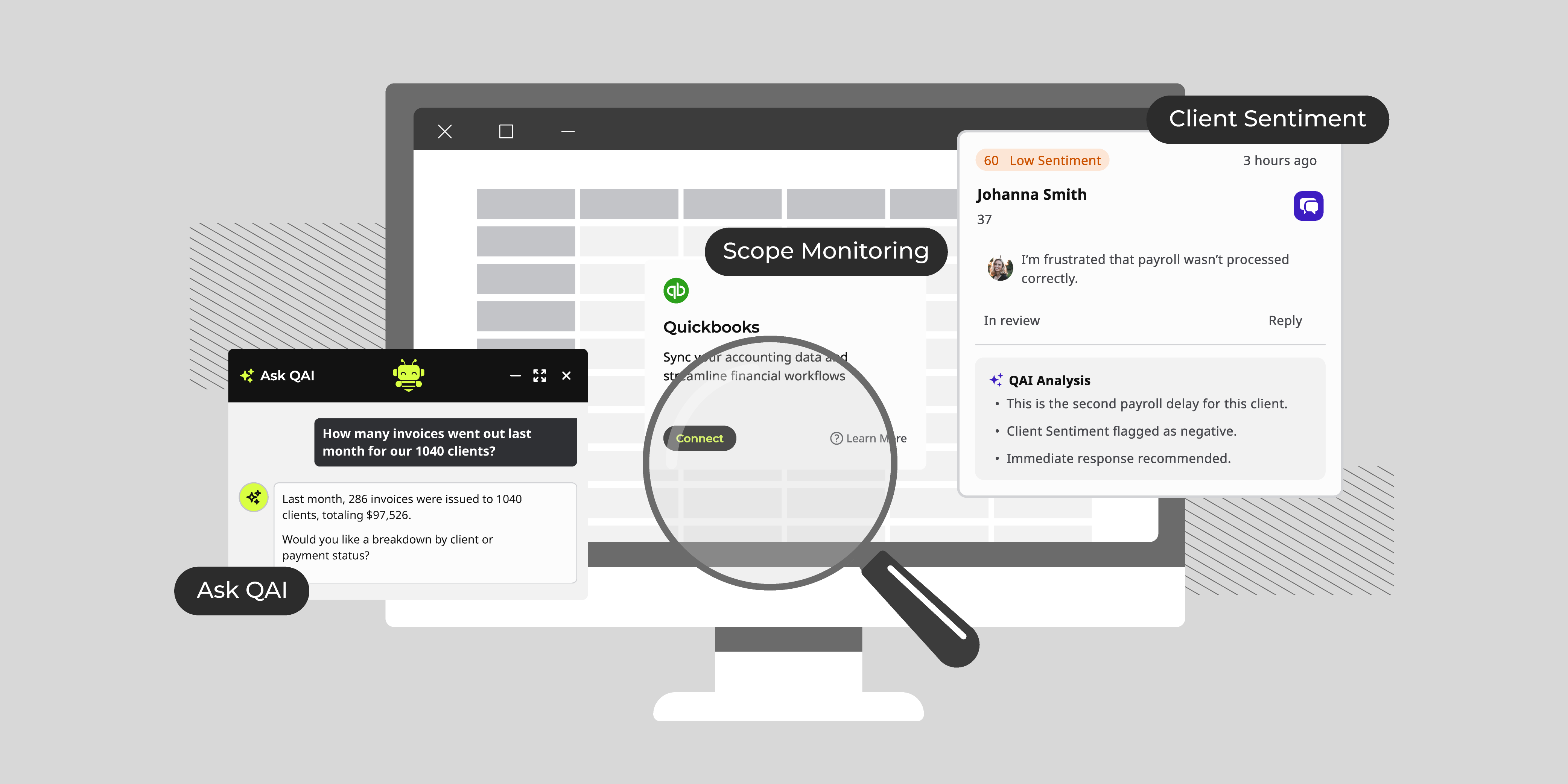
QAI also prioritizes work based on business impact. It evaluates factors such as deadlines, risk exposure, client value, and operational strain to help firms focus attention where it matters most. Qount’s newest tool, Ask QAI, gives staff a built-in interface to ask QAI questions in plain language and receive answers grounded in the firm’s operational and financial data.
When these responsibilities move off individual staff members, capacity opens up. Teams spend less time reconciling systems and more time delivering insights, guidance, and strategy. Because Qount operates as an all-in-one platform, staff do not need to learn or manage multiple tools to support advisory work. More importantly, it turns day-to-day operational data into timely prompts for advisory conversations, so the firm isn’t just faster, it’s more proactive and more consistent in how it guides clients.
The result is real, quantifiable impact, and a shift in how firms allocate their best talent.
Client Sentiment Tracking Enables Proactive Advisory
Strong advisory services depend on understanding how clients are actually experiencing the relationship.
QAI’s Client Sentiment Analysis helps firms monitor satisfaction signals across communications and interactions. This is especially important as CAS practices scale and teams manage larger advisory portfolios.
Sentiment analysis can surface early signs of frustration, disengagement, or churn risk. It can also highlight changes in communication tone or responsiveness that indicate a client may need more attention.
Beyond retention, sentiment tracking helps firms evaluate the quality of their advisory services. Patterns across clients can reveal where offerings resonate and where adjustments are needed. It can even offer a baseline that firms measure against as they improve their services. Most importantly, instead of learning about dissatisfaction after the fact, firms can respond while they can still make a difference for their clients.
AI-Powered Pricing Suggestions Bring Consistency to Advisory
Pricing advisory services historically involved guesswork. Complexity varies by client. Scope expands over time. And for many firms, billing decisions often rely on intuition rather than data.
QAI is designed to help firms analyze work complexity and effort so that pricing aligns more closely with reality. By tying advisory work back to time, scope, and outcomes, firms gain a clearer view of what services are truly worth.
This consistency matters when starting or scaling advisory services. Teams can price confidently without revisiting assumptions on every engagement. Staff also spend less time navigating billing questions and more time delivering high-value insights to clients.
Better pricing supports better realization, without forcing firms to choose between fairness and profitability.
What Firms Gain When QAI Becomes the Advisory Engine
When AI supports advisory work, firms see both measurable and experiential gains.
Advisory services become easier to scale across a larger client base because insights surface consistently and systematically. QAI learns from ongoing client interactions, helping teams quickly identify when clients need attention or when engagement is at risk.
Staff and partners reclaim time previously spent on manual data gathering and redirect it toward strategy, planning, and higher-value conversations. This leads to stronger advisory outcomes and more meaningful client relationships.
Pricing and scoping improve as work is tied back to actual effort and results. Firms gain clearer visibility into which advisory engagements drive value and which require adjustment.
With tools like Ask QAI, staff can access instant, data-backed answers to practical questions. For example, understanding how many hours were spent on advisory work for a specific client or evaluating the profitability of a CAS engagement, without the need for manual analysis.
The Outcome of Using AI for Client Advisory Services
Advisory and AI are both evolving quickly within the accounting profession. Firms that continue to operate reactively will struggle to keep up as the landscape continues to evolve.
Qount Artificial Intelligence empowers advisors to do their best work by removing friction, surfacing insights, and supporting better decisions, so guidance becomes consistent across every client, not dependent on manual analysis. And when QAI becomes the advisory engine, teams spend less time assembling information and more time making confident, data-backed decisions with clients.
See how Qount elevates advisory for your firm.